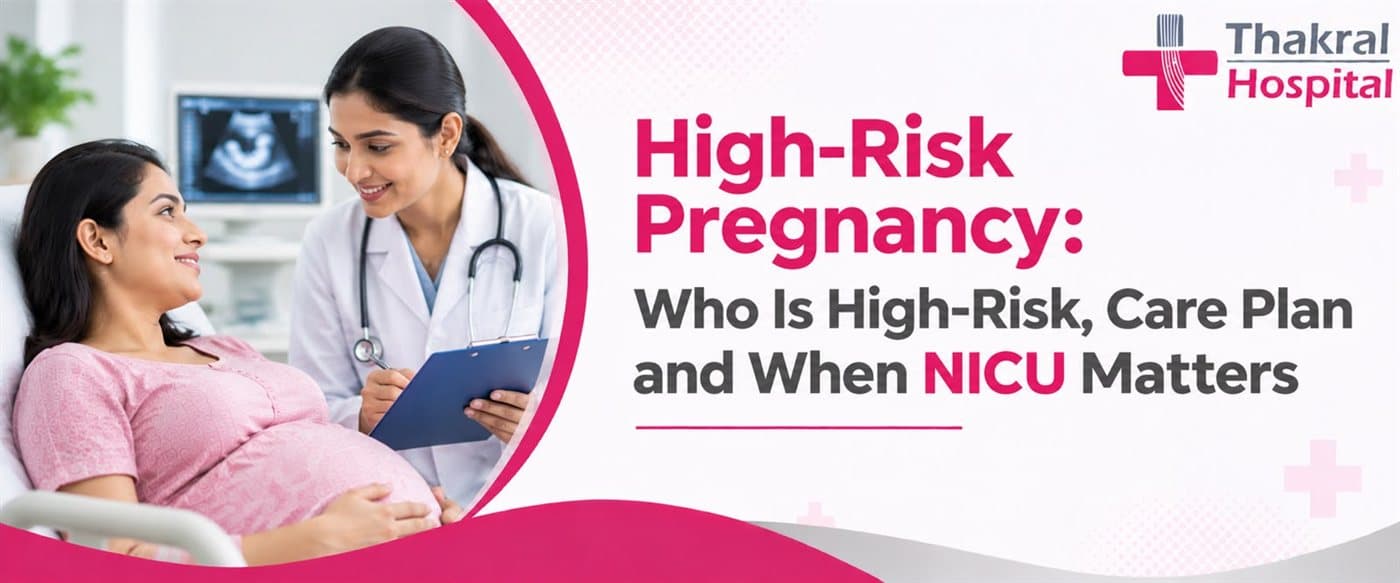
High-Risk Pregnancy: Who Is High-Risk, Care Plan and When NICU Matters
Reviewed by Dr. Neeru Thakral, Director and Senior Obstetrician and Gynaecologist, Thakral Hospital and Fertility Centre, Gurgaon.
A high-risk pregnancy is one in which the mother, the baby or both have a higher chance of complications than usual. It does not mean something will go wrong. It means you need more frequent visits, extra tests and a delivery plan made in advance at a hospital that can handle emergencies, including a newborn unit (NICU) when the baby may need special care. Most women with high-risk pregnancies deliver healthy babies with good care.
Hearing the words "high-risk pregnancy" can be frightening. Many women hear them for the first time at a routine visit: a blood pressure reading that is a little high, a sugar test that is abnormal, a scan that shows twins, or a history of a previous loss. This guide explains in plain language who is considered high-risk, what care usually looks like, how doctors plan the delivery, and how to understand NICU care. Our team looks after many such mothers every year, and what helps most is clear information and a plan.
What does "high-risk" actually mean?
Every pregnancy is watched, but some need a closer watch. "High-risk" is a label to guide care, not a prediction. Think of it like driving in fog: you do not stop; you slow down, switch on extra lights and pay more attention. A pregnancy can be high-risk from the beginning, or become high-risk later when something new appears.
Who is considered high-risk?
Because of age or general health
- Age under 18 or over 35.
- Being very underweight or overweight before pregnancy.
- Smoking, tobacco, alcohol or drug use.
Because of a medical condition you already have
- High blood pressure, diabetes, thyroid disease, kidney, heart or lung disease.
- Autoimmune conditions such as lupus or antiphospholipid syndrome. See our guide on lupus and miscarriage.
- Epilepsy, blood disorders or severe anaemia.
- Polycystic ovary syndrome (PCOS), which raises the chance of gestational diabetes in some women.
Because of earlier pregnancies
- Previous premature birth, stillbirth, repeated miscarriages or a baby with a birth defect.
- Pre-eclampsia or gestational diabetes in a past pregnancy.
- One or more earlier caesarean sections or uterine surgery.
Because of this pregnancy
- Twins or more.
- Pregnancy after fertility treatment such as IVF, which has a higher chance of twins and needs careful monitoring. Our IVF centre in Gurgaon continues care into pregnancy for this reason.
- Gestational diabetes, high blood pressure or pre-eclampsia that develops during pregnancy.
- Low-lying placenta (placenta praevia), poor baby growth, too little or too much amniotic fluid.
- Baby with a possible abnormality on a scan.
- Rh-negative blood group with a risk of antibodies.
- Infections in pregnancy.
- A short cervix or signs of early labour.
If you see yourself in this list, please do not panic. Many of these conditions are managed well. Tell your doctor so the plan is made early.
How the risk is found
At the first visit, the doctor takes your history, checks your blood pressure, weight and general health, and orders blood tests and a dating scan. Later checks include the first-trimester screening scan, the detailed anomaly scan at about 18 to 22 weeks, a glucose test at 24 to 28 weeks, and growth scans. These are often repeated for high-risk mothers. Our fetal medicine and radiology unit offers detailed scans, Doppler studies of blood flow and fetal echocardiography when needed.
What care looks like in a high-risk pregnancy
- More frequent visits. Often every two to four weeks, and weekly near the end, instead of the usual schedule.
- Extra tests and scans. Blood pressure checks, urine protein tests, blood sugar monitoring, growth and Doppler scans, and a non-stress test for the baby's heart rate in the third trimester if needed.
- Medicines to lower the risk. Examples are low-dose aspirin to reduce pre-eclampsia risk, blood-pressure medicines safe in pregnancy, insulin for diabetes, thyroid medicines, blood thinners for clotting disorders, or progesterone or a stitch on the cervix for a short cervix. Your doctor decides what is right for you.
- Treatment to help the baby's lungs. If an early delivery looks likely, steroid injections are given to help the baby's lungs mature.
- A team approach. Your obstetrician works with a physician, endocrinologist, cardiologist or rheumatologist as needed, along with a paediatrician and a dietitian.
- Home monitoring. Some women check blood pressure or sugar at home and note the baby's movements.
Our high-risk pregnancy care page describes how this works at our hospital, and Dr. Neeru Thakral and her colleagues in the obstetrician and gynaecologist team follow mothers from the first scan to delivery.
What you can do every day
- Keep every appointment and test, even when you feel well.
- Take your medicines and supplements exactly as prescribed.
- Follow the diet plan (for example, controlled sugar in gestational diabetes, lower salt if blood pressure is high).
- Rest as advised, and ask what activity is safe.
- Avoid tobacco, alcohol and over-the-counter medicines unless your doctor approves them.
- Learn your baby's usual movements and tell your doctor if they reduce.
- Get recommended vaccines, such as the flu and whooping cough (Tdap) vaccines, as advised.
Warning signs: call the same day, or go to hospital
- Vaginal bleeding or leaking of fluid.
- Regular tightening or pain before 37 weeks.
- Severe headache, blurred vision, sudden swelling of the face and hands, or pain under the ribs.
- Less movement from the baby.
- Fever, burning with urination, or severe vomiting.
- Chest pain, breathlessness, or a painful, swollen leg.
Planning the delivery
For many high-risk mothers, the plan covers three questions: when, how and where.
- When: Some conditions need delivery before the due date, for example, uncontrolled blood pressure, poor baby growth or twins in some situations. Waiting longer is better for the baby when it is safe.
- How: Many high-risk mothers can still have a normal delivery. A C-section is advised when it is safer. Our guide on C-section vs normal delivery explains how the choice is made.
- Where: Deliver in a hospital with an operation theatre, an anaesthetist and blood bank round the clock, and a newborn unit. This is the point where the choice of hospital matters most. If you know your pregnancy is high-risk, it is better to book the right hospital in advance than to move during an emergency.
When does a NICU matter?
A NICU (neonatal intensive care unit) cares for newborns who need extra breathing, feeding or monitoring support. Babies who may need it include:
- Premature babies, born before 37 weeks.
- Babies with low birth weight.
- Babies with breathing problems, low blood sugar or infection.
- Babies with significant jaundice needing light treatment.
- Babies of mothers with diabetes or other conditions, and some twins.
- Babies who did not cry or breathe well at birth.
Not all NICUs are the same
Newborn units are grouped into levels. A basic (Level I) unit looks after healthy term babies and can stabilise and care for many near-term babies. Higher-level units care for smaller or sicker babies and offer more advanced breathing support and specialists. Thakral Hospital provides Level I NICU and newborn care with paediatricians and neonatologists, as part of our paediatrics and neonatology department. If your doctor expects a very early or critically unwell baby, the best option is to plan the delivery at a hospital with the right level of care. Ask your doctor early which level of newborn care you will need and what arrangement the hospital has for transfer if it is needed.
Parents in the NICU
Ask the team how you can take part: skin-to-skin (kangaroo) care, expressing breast milk, being present for rounds, and getting regular updates. These help your baby and you.
Frequently asked questions
1. What is a high-risk pregnancy?
A pregnancy in which the mother or baby has a higher chance of complications than usual because of age, a medical condition, earlier pregnancy problems, or a condition in the current pregnancy.
2. Does a high-risk pregnancy mean something will go wrong?
No. It means closer monitoring and planning. Most high-risk pregnancies end with a healthy baby.
3. Who is at risk after the age of 35?
Women over 35 have a higher chance of gestational diabetes, high blood pressure, twins (especially after fertility treatment) and chromosomal changes in the baby, so extra screening is offered.
4. Is a pregnancy after IVF high-risk?
It is often watched more closely, especially for twins and for the mother's age and health, but many IVF pregnancies progress normally with careful monitoring.
5. Can I have a normal delivery in a high-risk pregnancy?
In many cases, yes. The decision depends on the condition and on how you and the baby are doing in labour.
6. How often will I need to visit the doctor?
Usually more often than usual, every two to four weeks, and weekly later in pregnancy, as your doctor decides.
7. When is a baby admitted to NICU?
If the baby is born early, is small, or has breathing, sugar, infection or jaundice problems, or needs closer observation.
8. What does Level I NICU mean?
It is a basic newborn care level for healthy term and near-term babies. Smaller or sicker babies may need a higher-level unit. Ask your hospital about its referral plan.
9. Can stress cause a high-risk pregnancy?
Stress alone does not cause it, but it can make blood pressure and sleep worse. Rest, counselling and support help.
10. How do I choose a hospital for a high-risk pregnancy?
Look for experienced obstetricians, detailed scans (fetal medicine), 24-hour theatre, anaesthesia and blood bank, a newborn unit on site, and a clear plan for emergencies.
Plan your care before the last month
Ready to plan your delivery? Book an antenatal consultation at our maternity hospital in Gurgaon. You can also call or WhatsApp +91-9971239503.
Tags
Content Created By:
Dr. Neeru Thakral
Director & Sr. Obstetrician-Gynaecologist, Infertility Specialist — 32+ years of experience